
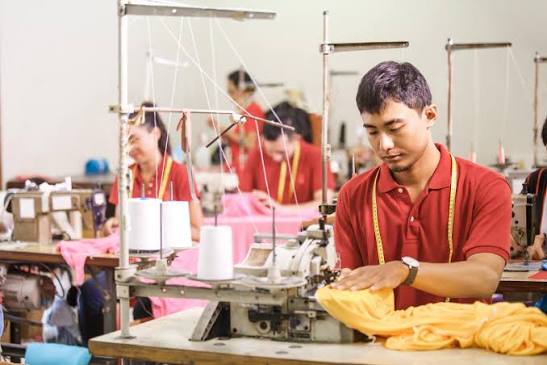
The textile and textile products (TPT) industry believes that Indonesia's economic growth of above 5 percent has not fully driven the recovery of the national manufacturing industry. While public consumption remains relatively stable, the strong influx of imported goods is seen as putting further pressure on the domestic industry and disrupting the national supply chain.
Redma Wirawasta, Chairman of the Indonesian Filament Fiber and Yarn Producers Association (APSyFI), stated that national economic growth is still largely supported by public consumption. However, the benefits of this growth have not yet been fully felt by domestic industry players.
"Economic growth is above 5 percent, and public consumption and purchasing power are still quite good, even though growth is weakening," Redma said on Thursday (August 13, 2026).
According to him, the main problem currently facing the industry is the increasing influx of imported products in various sectors. This situation not only increases dependence on goods and raw materials from abroad but also has the potential to damage the industrial ecosystem and the domestic value chain.
"This growth is dominated by imported goods, which continue to infiltrate all sectors, damaging the domestic ecosystem and value chain, making us increasingly dependent on imported goods and raw materials," he said.
Redma assessed that the statistical growth figures for the textile and textile industry do not fully reflect the true situation. This growth is driven, in part, by new investment, but does not take into account the lost production capacity due to the closure of several factories over the past three years.
According to him, several factories that ceased operations had to sell or scrap their production machinery. Meanwhile, the new investment has not been able to fully replace the production capacity or workforce lost due to factory closures and the wave of layoffs.
"In terms of production volume and employment, this new investment is not yet equal to the factory closures and layoffs that occurred in the past three years," he explained.
Redma also highlighted the effectiveness of various government policies to control imports of textile products. He said the government has issued numerous regulations, but their implementation has not been strong enough to protect the domestic industry.
"We see no policies that seriously protect. There are many policies, but they are just playing around," he stressed.
The influx of imported products is also considered to have a broader impact on the economy. According to Redma, layoffs in the textile and textile industry are gradually squeezing people's purchasing power. At the same time, the domestic raw materials industry is also facing pressure, with some producers even having to cease operations.
This situation makes it increasingly difficult for downstream industries to absorb local raw materials because they must compare their prices with imported products, which come in at very low prices or are suspected of using dumping practices.
"So, imports are the main cause, even though our energy prices and wages are more competitive than those of competing countries," he said.
The pressure on the industry is also exacerbated by financing issues. Banks are considered to still view the textile and textile industry as a high-risk sector because companies' ability to dominate the domestic market is increasingly being pressured by imported products. Cash flow disruptions then make it difficult for companies to make investments, including modernizing production machinery.
In the increasingly competitive environment, companies are even said to be having to sell their products below the cost of production (COGS) to remain competitive with imported goods. If these conditions continue, the industry's ability to survive and make long-term investments will be increasingly limited.
Redma believes the government needs to take more serious steps to rebuild the strength of the national textile and textile industry. One of the main priorities is ensuring that the domestic market and national supply chain are dominated by domestic producers.
"The government must seriously strive to ensure that the domestic market and supply chain are dominated by domestic producers. Don't just talk and give false hope," he emphasized.
According to him, strengthening the domestic market is a crucial factor so that new investment is not merely reflected in statistics, but is truly capable of restoring production capacity and jobs lost due to factory closures in recent years.
Without controlling the flow of imports and strengthening the industry from upstream to downstream, national economic growth is considered at risk of not having an optimal impact on the manufacturing sector. The textile and textile industry also requires policies that not only encourage new investment but also ensure that domestic producers have sufficient space.