
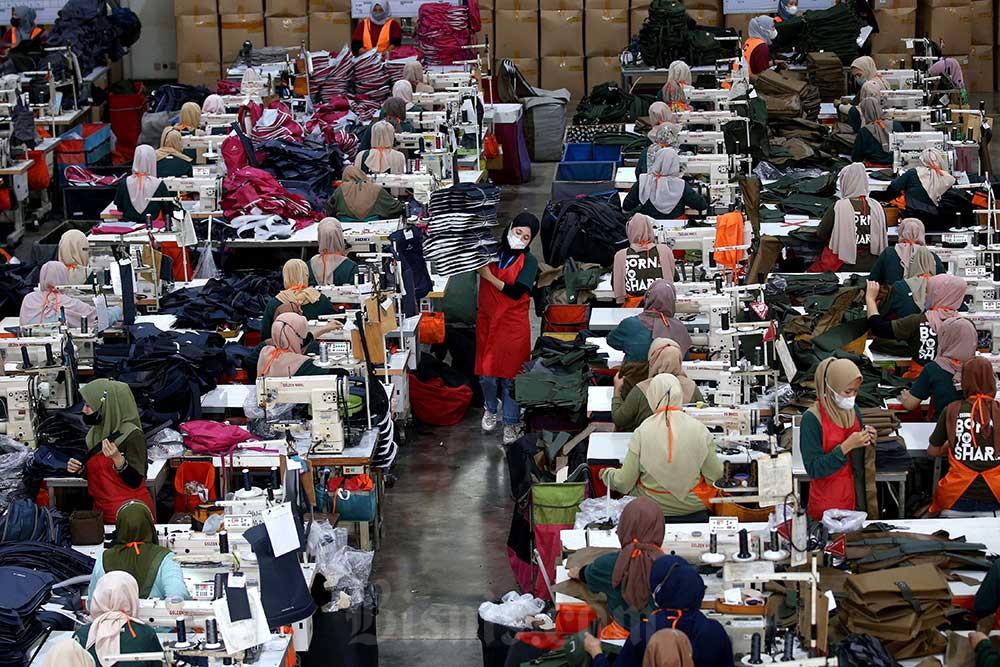
The national textile and textile products (TPT) industry is facing increasing pressure in mid-2026. Soaring production costs due to rising raw material prices, the weakening rupiah exchange rate, and fluctuations in global oil prices are making it difficult for industry players to maintain competitiveness amidst weakening market demand.
Farhan Aqil Syauqi, Secretary General of the Indonesian Filament Fiber and Yarn Producers Association (APSyFI), stated that this situation poses a major challenge for the upstream textile industry. He stated that the increase in production costs cannot be fully passed on to consumers due to the public's still weak purchasing power.
"Our members are feeling this this month because their purchasing power has decreased, and the market is having difficulty accepting our prices amidst the fluctuating rupiah exchange rate and global oil prices. This is probably our toughest month in 2026," Farhan said on Wednesday (July 1, 2026).
Farhan explained that the fiber and filament yarn industry relies heavily on naphtha-based raw materials, so changes in global oil prices directly impact production costs. As a result, producers face pressure from two sides: rising manufacturing costs and a weakening market ability to absorb products at adjusted prices.
To help maintain the industry's sustainability, APSyFI is requesting government support through various fiscal incentives. One proposal is providing Value Added Tax (VAT) discounts and other tax incentives to reduce production costs.
Furthermore, industry players are still awaiting confirmation of the natural gas price adjustment policy from the Ministry of Energy and Mineral Resources (ESDM) and PT Perusahaan Gas Negara Tbk. (PGN). The certainty of the liquefied natural gas (LNG) tariff of US$13 per MMBTU is considered crucial to maintaining factory operational efficiency amidst high energy costs.
"We hope the government will pay attention to reducing the price of our raw materials. Our raw materials follow global oil prices because they are derived from naphtha. Our proposals include VAT discounts or other tax incentives to reduce our production costs," said Farhan.
The pressures experienced by the textile industry are also reflected in the performance of the national manufacturing sector. According to an S&P Global report, Indonesia's Manufacturing Purchasing Managers' Index (PMI) fell to 46.9 in June 2026 from 50.0 in May, re-entering the contraction zone.
In the PMI indicator, a reading above 50 indicates expansion in manufacturing activity, while a reading below 50 indicates contraction. This decline indicates a slowdown in production activity and demand in the manufacturing sector.
S&P Global Market Intelligence economist Usamah Bhatti stated that the health of Indonesia's manufacturing sector has weakened for the second time in three months. The decline in new orders contributed to the deepest contraction in production volume since April 2025.
"The rate of decline is the strongest in a year. New order inflows have declined again, leading to the largest decline in output volume since April 2025," said Usamah.
S&P Global also noted that weak domestic demand due to declining purchasing power was one of the main factors depressing the manufacturing PMI. On the other hand, export demand also experienced a significant decline due to rising product prices, even marking the deepest decline since August 2021.
This situation indicates that the national textile industry still faces significant challenges, both in terms of rising production costs and slowing demand in domestic and international markets. Businesses hope that government policies will soon provide the industry with the space to maintain competitiveness and ensure production continuity amidst global economic pressures.