
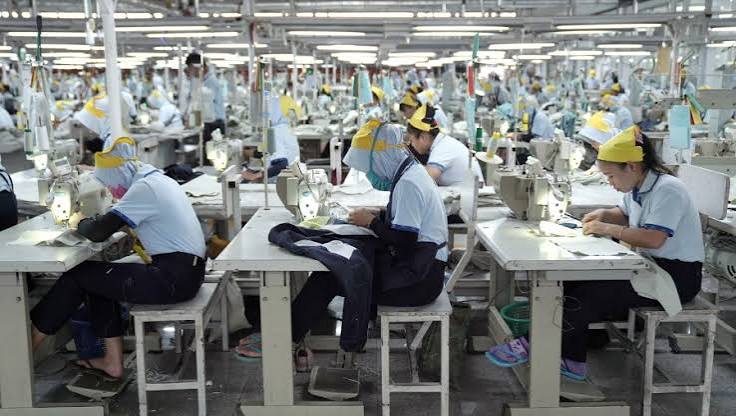
A wave of layoffs has continued to hit several industries this year, with the textile and textile products (TPT) sector suffering the most severe impact.
The Indonesian Synthetic Fiber and Filament Yarn Producers Association (APSyFI) said the recent depreciation of the rupiah has further strained the cash flow of many upstream textile manufacturers. The weaker currency has driven up the cost of imported raw materials, forcing companies to cut production and reduce spending.
APSyFI Chairman Redma Gita Wirawasta explained that many companies have already begun terminating contract workers as part of their efforts to maintain financial stability.
"To keep cash flow running, many companies have reduced raw material purchases and scaled back production. We have not yet reached the stage of mass layoffs for permanent employees, but many contract workers have already had their contracts terminated," he said in a statement on Wednesday (June 24).
Indonesia's weakening economic conditions, particularly in the financial sector, have caused many textile manufacturers in West Java to shut down operations. As a result, the province has recorded the highest number of layoffs nationwide, accounting for more than 21 percent of all layoff cases in Indonesia.
According to data from the Ministry of Manpower, 23,470 workers lost their jobs between January and May 2026 alone. The number is expected to continue rising over the next three months unless economic conditions improve significantly.
The layoff wave is also expected to spread to other strategic industries, including manufacturing, retail, and the tobacco products industry. Statistics Indonesia (BPS) reported that the tobacco industry contracted by 4.05 percent year-on-year in the first quarter of 2026, following a 4.97 percent decline in the previous quarter.
Other manufacturing sectors experiencing contractions include the transportation equipment industry, which declined by 5.02 percent, and the rubber, rubber products, and plastics industry, which contracted by 9.01 percent.
House of Representatives Commission VII member Novita Hardini described the tobacco industry as a strategic sector that contributes hundreds of trillions of rupiah to the national economy while supporting the livelihoods of millions of Indonesians.
"Policies affecting the tobacco sector must be implemented in a balanced manner because the tobacco industry is not merely a consumer goods industry, but a strategic national sector that supports a long economic value chain from upstream to downstream," she said.
BPS data show that the tobacco manufacturing industry directly employs approximately 1.58 million workers across micro, small, medium, and large enterprises. This figure does not include supporting sectors such as tobacco farmers and retailers, which the Ministry of Industry estimates bring total employment within the tobacco ecosystem to around six million people.
Despite facing pressure from weak market conditions, the tobacco industry is also concerned about several proposed public health regulations. The Ministry of Health is preparing policies that include plain packaging requirements, limits on nicotine and tar content, and restrictions on flavoring additives in cigarettes.
Industry stakeholders argue that plain packaging could encourage the growth of the illegal cigarette market, reducing legal cigarette sales and production. They also contend that proposed nicotine and tar limits would be difficult for domestic tobacco producers to meet, while banning flavor additives could further disrupt production.
Virtually all stakeholders within the tobacco supply chain—including manufacturers, farmers, retailers, and traders—have voiced opposition to the proposed regulations. Indonesian Cigarette Manufacturers Association (GAPPRI) Chairman Henry Najoan urged the government to withdraw the plain packaging proposal from the draft Minister of Health regulation.
Henry noted that when tobacco excise rates remained unchanged in 2019, Indonesia's cigarette production reached 357 billion sticks. However, production has continued to decline between 2020 and 2025, including a 3 percent drop from 2024 to 2025.
"Stricter regulations could encourage the circulation of illegal cigarettes. Ultimately, this would harm state revenue and create distortions in the market," Henry said.
Similar objections have also been expressed by tobacco farmers, traders, and retail businesses, who argue that unbalanced non-fiscal regulations would only weaken the tobacco industry and negatively affect millions of people who depend on the sector for their livelihoods.